I Discovered a 25x Faster Alternative to Redis at AWS Summit — Here’s What I Learned
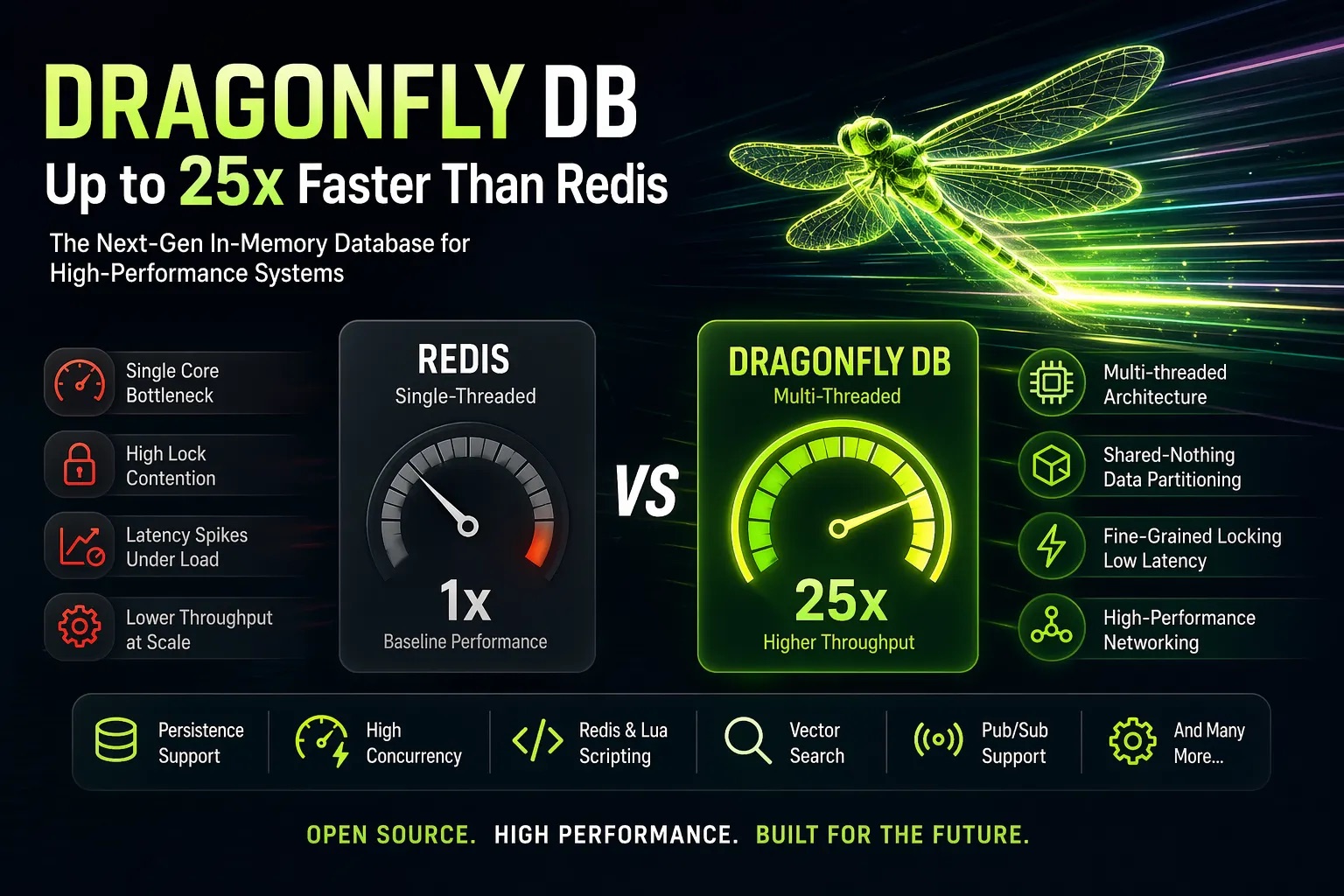
I happened to be at AWS Summit recently, and I came across a company that genuinely caught my attention. It wasn’t just another tool or startup pitch. It was something that made me pause and think:
“Wait… how is this even possible?”
The company is DragonflyDB, and they claim their in-memory database can be up to 25x faster than traditional Redis. Yes, you read that right.
Before dismissing this as marketing hype, I spent some time understanding how they achieve it, and it turns out there are some very interesting engineering decisions behind it.
How Dragonfly Achieves This Speed
1. Multi-threaded Architecture
Most of us know that Redis is largely single-threaded when it comes to command execution. Dragonfly takes a different approach: it uses a multi-threaded architecture, allowing multiple CPU cores to process operations in parallel.
What this means:
- Better CPU utilization
- Higher throughput
- No single-core bottleneck
This alone can lead to massive performance gains on modern multi-core machines.
2. Shared-Nothing Data Partitioning
Dragonfly internally partitions data so that each thread operates on its own subset, with minimal shared state. It’s a classic distributed systems idea applied within a single machine.
The result:
- Less contention between threads
- Reduced locking
- Better scalability under load
3. Fine-Grained Locking
Traditional systems often suffer from threads blocking each other, lock contention, and latency spikes under heavy traffic. Dragonfly addresses this with fine-grained locking and lock minimization.
The result:
- More predictable performance
- Consistent low latency
- Better behavior under high concurrency
4. Efficient Memory Management
Memory efficiency plays a huge role in performance. Dragonfly focuses on a better memory layout, reduced fragmentation, and improved cache locality. In short: faster reads, faster writes, and lower overhead.
5. High-Performance Networking
Handling high QPS isn’t just about storage; it’s also about networking. Dragonfly is optimized to handle large numbers of connections, reduce syscall overhead, and process requests efficiently.
More Than Just Speed
Beyond performance, Dragonfly comes with a solid feature set:
- Redis-compatible API
- In-memory key-value storage
- Persistence support
- High concurrency handling
- Lua scripting (like Redis)
- Built-in caching capabilities
- Pub/Sub support
- Vector similarity search
And yes, it’s open source.
A Quick Reality Check
As exciting as this sounds, it’s important to stay grounded. Dragonfly is incredibly fast, but that doesn’t mean it replaces everything.
It’s best suited for:
- Caching layers
- Rate limiting
- High-throughput ephemeral workloads
It’s not meant to replace:
- Your primary database
- Long-term storage systems
My Takeaway
What impressed me wasn’t just the “25x faster” claim. It was the engineering philosophy behind it:
Fully utilizing modern multi-core systems while minimizing contention.
That’s a powerful idea.
Learn More
- Website: dragonflydb.io
- GitHub: github.com/dragonflydb/dragonfly